

From Pistons to Processors: How Chips Conquered the Car.
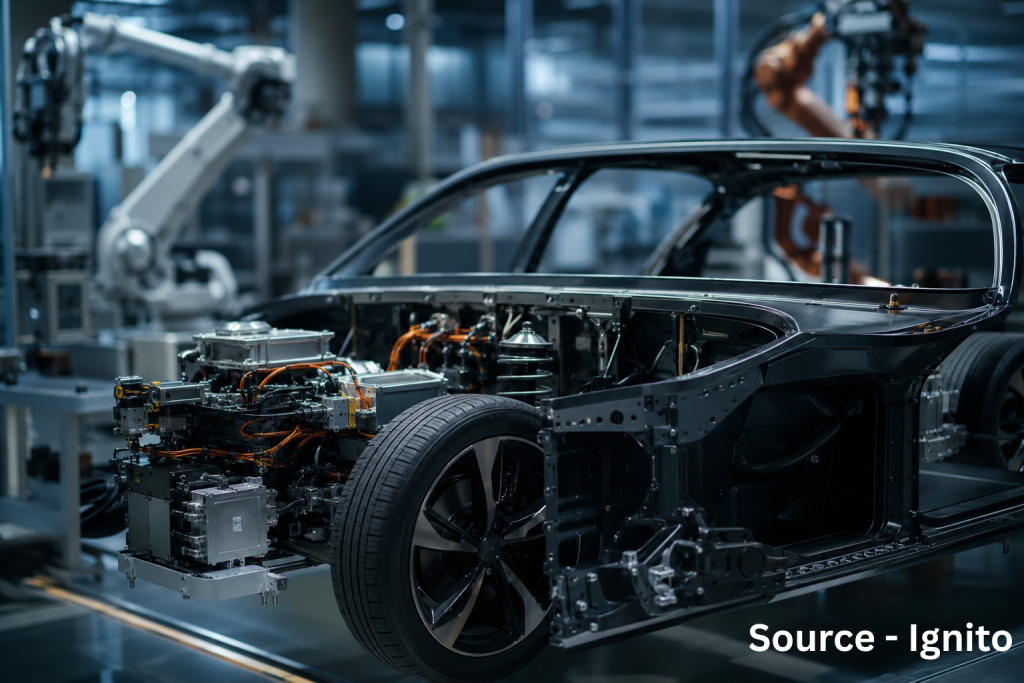
Silicon has quietly overtaken steel as the most consequential material in a modern vehicle. The industry building these cars is being remade from the ground up and the transformation is only accelerating.
Something shifted in the global auto industry over the past two years not on the racetrack or the showroom floor, but deep inside the factory. The engineers writing code are now as critical to vehicle production as the ones welding chassis. The chips being sourced matter as much as the steel being stamped. And the companies that once defined automotive excellence purely through horsepower are now competing on software release cycles.
This is not the future. This is 2026, and automobile electronics have become the defining force across every sector of the industry from how cars are designed and assembled, to how they are sold, updated, and kept safe on the road.
To understand why, start with a number. A modern mid-range car now carries anywhere from 70 to 100 Electronic Control Units small dedicated computers, each managing a specific function. Braking. Climate. Airbags. Fuel injection. A fully loaded luxury or EV model pushes that to 150 or more. Every one of those ECUs is a manufacturing decision, a supply chain dependency, and a software maintenance obligation. The car, in other words, has become a rolling data center. And like every data center, it needs to be redesigned when a better architecture comes along.
“Silicon is the new horsepower. As we look toward 2026, centralization is the new standard and AI is the new interface.” – S&P Global Mobility / Financial Content, Dec 2025
That redesign is now underway and its name is the Software-Defined Vehicle, or SDV. Rather than scattering dozens of ECUs across a car, manufacturers are consolidating everything into a handful of powerful central computers linked by a zonal architecture. Think of it like moving from a building where every room has its own fuse box to one controlled by a single smart panel. The result: fewer components, dramatically less wiring shaving tens of kilograms off vehicle weight in some designs and a platform that can be upgraded over the air, like a smartphone. A survey of 86 automotive OEM and supplier executives, published by IoT Analytics in December 2025, found that 45% now rank the SDV transition as their single most important strategic priority higher than ADAS development (25%) and EV rollout (14%) combined.
For semiconductor manufacturers, the shift has redrawn the competitive map entirely. The old automotive chip a modest 8-bit or 16-bit microcontroller built for durability is giving way to 32-bit real-time processors and multi-core Systems-on-Chip built on 5nm and 3nm process nodes. These are the same cutting-edge fabrication nodes found in flagship smartphones. The latest central compute platforms entering production deliver over 2,000 TOPS tera operations per second a level of raw compute that would have been unthinkable inside a passenger vehicle five years ago. S&P Global Mobility projects automotive semiconductor revenue will grow from roughly $90 billion in 2025 to $139 billion by 2031, a 7.5% CAGR that far outpaces growth in actual vehicle production over the same period. The chip, not the car, is where the value is accumulating.
This has brought entirely new players into the manufacturing ecosystem. Nvidia and Qualcomm companies that built their reputations in gaming GPUs and mobile processors now supply the high-performance compute platforms sitting at the heart of next-generation vehicles. NXP and STMicroelectronics are developing the specialized zonal gateway chips that connect these central compute units to the physical sensors and actuators distributed across the car. Meanwhile, the facility investments tell their own story: in Q2 2025, Magna International opened a dedicated electronics manufacturing plant in Querétaro, Mexico, to produce ADAS components at scale. In mid-2024, Infineon Technologies inaugurated a $1.8 billion power semiconductor facility in Malaysia built specifically to meet EV and automotive demand. The supply chain is being physically rebuilt to match the new vehicle architecture.
On the factory floor itself, the transformation is equally visible. Autonomous manufacturing cells now deploy Vision AI to inspect components at a resolution and consistency no human quality team could match. Industrial IoT sensors stream real-time data from assembly lines, flagging anomalies before they become defects. Digital twins complete virtual replicas of a vehicle’s hardware and software stack allow engineers to simulate an entire car’s electronic behavior before a single physical prototype is built. At CES 2026, Siemens unveiled its PAVE360 Automotive platform specifically to address this need, promising to compress software validation timelines from months to days by enabling full-system virtual integration off the physical vehicle entirely.
The economics of all this are changing how OEMs make money, too. When a car’s features are defined by software rather than hardware, manufacturers can sell upgrades post-purchase activating performance boosts, enabling new safety features, unlocking premium infotainment without the customer ever visiting a dealership. A 2026 global SDV survey by Omdia and Sonatus, covering 559 automotive professionals across seven major markets, found that 67% of respondents have already deployed over-the-air updates in their vehicles, with 78% expecting broad OTA capability across all vehicle systems by 2027. The point of sale is no longer the end of the revenue relationship. It’s the beginning of one.
“For 45% of automotive OEMs, the transition to software-defined vehicles is now their single biggest strategic priority ahead of ADAS, ahead of EVs.” IoT Analytics SDV Adoption Report 2026, survey of 86 OEM executives
China, predictably, is moving fastest. Domestic manufacturers like BYD, NIO, Xpeng, and Leapmotor have adopted centralized compute architectures from day one, treating the car as a continuously updated software product rather than a depreciating hardware asset. NIO’s proprietary SkyOS, launched in 2024, manages hardware across the entire vehicle through a single operating system. In 2024, over 438,000 integrated cockpit-driving domain controller units combining infotainment and ADAS onto a single chip were installed in Chinese passenger cars alone, across more than 20 models. The legacy Western approach of bolting software onto hardware after the fact is under direct, intensifying competitive pressure.
But with greater electronic complexity comes a harder problem: security. A car with a central compute platform, persistent cloud connectivity, and over-the-air update capability is, by definition, a networked device. And networked devices get attacked. Automotive cybersecurity is no longer an afterthought it is a core engineering discipline, governed by international standards and increasingly built into the silicon itself. Zonal architectures create natural security boundaries within the vehicle, limiting how far a breach can propagate. Encryption, real-time anomaly detection, and hardware-level security enclaves are now standard requirements for any chip entering the automotive supply chain a shift Infineon directly addressed in its June 2026 announcement of a quantum-era certified TPM solution for automotive AI platforms.
What is being built, when you step back and look at the full picture, is not just a smarter car. It is an entirely new manufacturing paradigm one where software release cycles dictate production roadmaps, where a chip fab in Malaysia affects vehicle availability in Mumbai, and where the most valuable intellectual property a carmaker owns may not be its engine design but its operating system. The automobile electronics revolution is not coming. It already arrived. The industry is simply catching up to what it has already become.
Sources & data verification
Market size ($283.8B, 8.6% CAGR): GMI/ResearchAndMarkets, 2025. Auto semiconductor ($90B–$139B, 7.5% CAGR, 2025–2031): S&P Global Mobility, April 2026. SDV priority survey (45% of OEMs, n=86): IoT Analytics SDV Adoption Report 2026, Dec 2025. OTA deployment (67% vehicles, 78% by 2027): Omdia/Sonatus SDV Survey 2026, n=559. ECU count (70–150 depending on vehicle class): multiple sources incl. ENNOVI, JD Power, Robotics & Automation News, 2025–26. China cockpit-driving domain controllers (438,600 units, 20+ models, 2024): ResearchAndMarkets China Cockpit Domain Controller Report, 2025. Magna Mexico plant: MarketResearchFuture, Q2 2025. Infineon Malaysia ($1.8B): MarketResearchFuture, Q2 2024. Siemens PAVE360: Siemens press release, CES 2026. Infineon TPM/quantum: Infineon press release, June 2026.
– by Aditya Saha Jr.