
Amber Enterprises Bets Big on Electronics Manufacturing With ₹2,000 Crore Capex Push Amid Margin Pressure
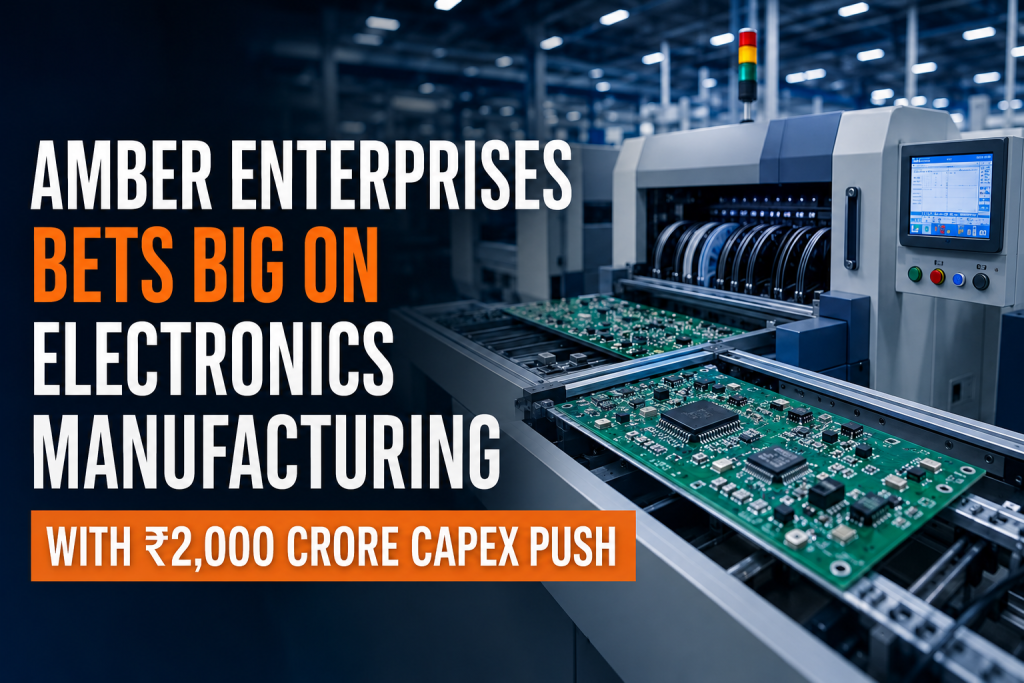
Amber Enterprises India is accelerating its transition from a traditional room air conditioner manufacturer into a major electronics manufacturing and PCB production player, backed by a massive ₹1,800–2,000 crore capital expenditure plan for FY27.
The company delivered a strong Q4 FY26 performance driven by robust growth in its electronics and railway sub-systems businesses, even as margin pressure and elevated stock valuations triggered investor caution.
Electronics Division Emerges as Key Growth Engine
Amber’s electronics manufacturing services (EMS) division has rapidly become the company’s biggest growth driver. The segment reported nearly 49% growth in FY26 and is expected to continue expanding at around 40% in FY27.
The growth has been supported by strategic acquisitions including Ascent Circuits, Power-One, and Unitronics, along with its partnership with Korea Circuit for entry into high-growth PCB segments such as HDI and semiconductor substrate PCBs.
The company is also constructing a multi-layer PCB manufacturing facility in Hosur, strengthening India’s domestic electronics manufacturing ecosystem and supporting the government’s import substitution strategy under the ‘Make in India’ vision.
Amber’s aggressive expansion comes at a time when India is rapidly positioning itself as a global electronics manufacturing hub, with policy support through schemes like ECMS and semiconductor incentives.
RAC Business Shows Recovery Amid Heatwave Demand
Amber’s core RAC business remained resilient despite a weak start to FY26 caused by inconsistent weather conditions and rising commodity prices.
The segment posted around 7% year-on-year growth in Q4 FY26 and 14% growth for the full fiscal year. Demand improved sharply after mid-April heatwaves across India boosted air-conditioner sales.
Industry growth is expected to remain strong in FY27, supported by increasing cooling demand and localisation efforts. Recent government restrictions on importing room AC compressors below two tons are also expected to boost domestic manufacturing opportunities.
Railway and Mobility Segment Adds Momentum
The Railway Sub-systems and Mobility business also emerged as a strong performer, recording 22% growth during Q4 FY26.
Amber currently holds an order book of nearly ₹2,600 crore, supported by metro rail and Vande Bharat-related projects. The company expects this segment to grow by 30–35% in FY27.
Massive Capex Plan Signals Long-Term Manufacturing Ambition
Amber’s ₹2,000 crore capex roadmap reflects its long-term ambition to become a major domestic manufacturing powerhouse across electronics, PCB production, and industrial systems.
The company recently strengthened its balance sheet through QIP and CCPS fundraising worth approximately ₹2,707 crore to support this expansion phase.
Industry experts believe the move aligns closely with India’s broader strategy to deepen electronics localisation, reduce import dependency, and expand high-value manufacturing capabilities.
Margin Pressure and Valuation Concerns Remain
Despite strong revenue growth, Amber’s operating margins declined by nearly 50 basis points due to rising raw material costs and currency depreciation.
Copper clad laminate prices and foreign exchange volatility continue to pressure profitability, although the company expects gradual cost pass-through over the coming quarters.
Investor sentiment also weakened after the company’s Q4 results announcement, with the stock falling sharply amid concerns around premium valuations and earnings sustainability.
Amber currently trades at elevated valuation multiples compared to peers in both the RAC and EMS sectors.
Long-Term Outlook Remains Strong
Despite near-term challenges, analysts remain optimistic about Amber’s long-term positioning within India’s rapidly expanding electronics manufacturing ecosystem.
India’s electronics sector is projected to cross USD 600 billion by 2030, while the RAC market is expected to witness significant growth over the next few years.
Amber’s strategic push into high-value electronics manufacturing, PCB localisation, and mobility systems could place the company among the major beneficiaries of India’s manufacturing transformation story.