
India’s Electronics Export Ambitions Take Centre Stage at Department of Commerce Chintan Shivir
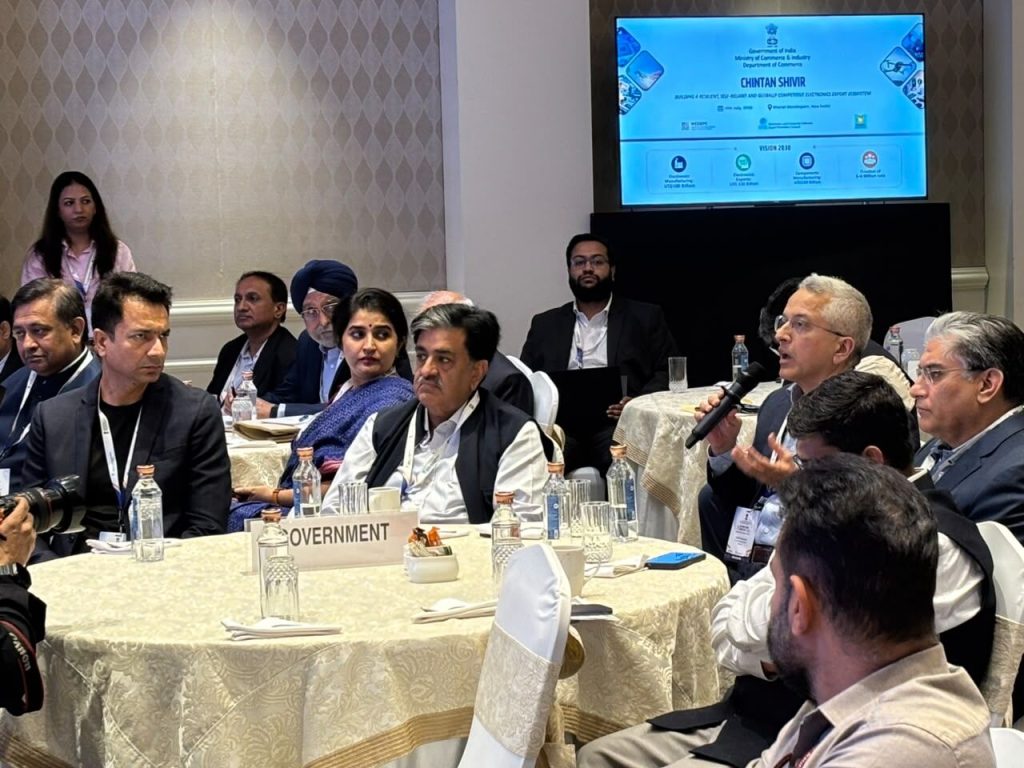
The Department of Commerce, in collaboration with the Mobile and Electronic Devices Export Promotion Council (MEDEPC), the Electronics and Computer Software Export Promotion Council (ESC), and the Telecom Equipment and Services Export Promotion Council (TEPC), organised a Chintan Shivir in New Delhi to deliberate on India’s evolving electronics manufacturing landscape and strategies to strengthen the country’s global competitiveness.
The Chintan Shivir brought together leading names across the electronics value chain Apple, Samsung, Tata Electronics, Dixon Technologies, Foxconn, Amber Enterprises, Micromax, Syrma SGS Technology, boAt, Aequs, and Bora Exim, among others alongside senior officials from the Department of Commerce, the Directorate General of Foreign Trade, state governments, and export promotion councils.
Commerce Secretary Rajesh Agrawal set the tone for the discussions, noting that as the global electronics industry is increasingly driven by global value chains, India’s policy framework must provide the predictability and stability that these value chains require to deepen their presence in the country. He underscored that policies aimed at domestic production may differ from those needed to drive export-oriented manufacturing, calling for balanced and actionable recommendations equitable for all stakeholders.
Presentations at the Chintan Shivir outlined India’s roadmap to achieving $150 billion in electronics exports by 2030, with sector-specific export opportunities mapped across smartphones, servers, speciality electronics, and components. India’s electronics exports stood at nearly $48 billion in FY 2025-26, a 24.7% increase over the previous fiscal a trajectory that places the $150 billion target within reach, but only with sustained policy alignment.
Several priorities emerged clearly from the deliberations. Participants stressed the need to resolve long-standing ambiguities around customs processes and permanent establishment norms to inspire greater confidence among global companies. Strengthening GVC integration was identified as equally critical enabling regional warehousing, merchant trading, and multi-vendor sourcing models that global supply chains increasingly depend on. Harmonisation of HS Codes and closer coordination with customs authorities to minimise product misclassification were also flagged as immediate operational priorities that directly affect export competitiveness.
The importance of integrating MSMEs into global value chains which account for nearly 90% of global electronics trade was a recurring theme, with participants calling for targeted support to help smaller manufacturers scale as suppliers to large OEMs and EMS companies. The Department of Commerce also indicated that the Indian Institute of Foreign Trade (IIFT) would develop training programmes for exporters to strengthen understanding of trade agreements, market access opportunities, and evolving global demand patterns.
Welcoming the Chintan Shivir, ICEA Chairman Pankaj Mohindroo noted that India’s ambition to become a global electronics manufacturing and export powerhouse will ultimately be determined by how effectively the country integrates into global value chains. He highlighted policy certainty, quality standards, deeper domestic value addition, and GVC-enabling models as the four pillars that must be strengthened in parallel. “With continued policy support and close government-industry collaboration, India is well positioned to emerge as one of the world’s most competitive destinations for electronics manufacturing and exports,” he said.
The Chintan Shivir concluded with a commitment from all participants to continue consultations and translate the recommendations into concrete policy initiatives.