
Beyond Silicon: Why Graphene, SiC, and GaN Are India’s Next Electronics Frontier
India’s electronics manufacturing story has largely been told through silicon mobile phones, IT hardware, ATMP facilities, and fab investments that dominate every policy headline. That story is real, and the numbers behind it are staggering. But it has quietly obscured a more consequential shift happening one layer deeper: the materials powering the next generation of electronics are no longer the same ones that built the last.
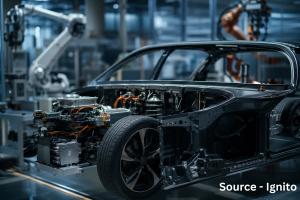
Silicon, for all its dominance, is approaching its physical limits. As power demands from electric vehicles, AI data centres, and 5G infrastructure keep climbing, silicon’s thermal ceiling and switching inefficiencies become bottlenecks that cannot be engineered away. That gap is exactly where Silicon Carbide, Gallium Nitride, and Graphene step in not as exotic lab curiosities, but as industrial materials actively entering production lines. SiC has become the standard for EV traction inverters, capable of operating at temperatures and voltages that silicon cannot sustain. GaN now sits inside every fast-charger, every aerospace power module, every high-frequency radar. Graphene, with electron mobility that surpasses silicon by orders of magnitude, is the longer game enabling flexible electronics, biosensors, and transistors that the current generation of devices cannot replicate.
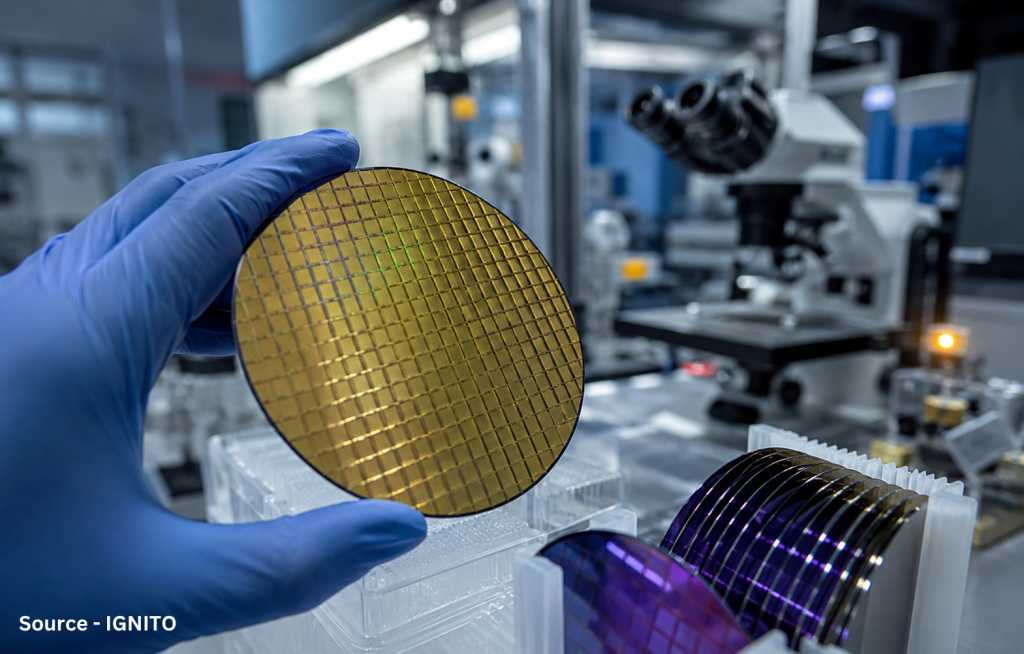
India’s semiconductor mission has already begun acknowledging this. In August 2025, India’s first commercial SiC fabrication facility was approved in Bhubaneswar, in partnership with UK-based Clas-SiC Wafer Fab, a quiet but significant departure from India’s silicon-first narrative. By May 2026, Crystal Matrix Limited received approval for an integrated GaN compound semiconductor facility in Dholera, introducing GaN epitaxy on six-inch wafers for Mini/Micro-LED display modules. These are the components demanded by next-generation smartphones, smartwatches, and AR displays categories where India already has massive domestic consumption and growing export ambition.
Yet approvals alone don’t close the gap. India continues to import virtually all of the advanced material inputs its electronics sector requires SiC substrates, GaN wafers, high-purity graphene almost entirely from China, the US, and Europe. The Covid-era chip shortage made visible what was always true: electronics manufacturing that depends on foreign material supply chains is manufacturing with a structural vulnerability baked in. Compound semiconductor materials are the next chokepoint, and India is building device capacity without yet securing material sovereignty.
That is the intervention ISM 2.0, announced in Union Budget 2026-27, is designed to address. By expanding the mission’s scope beyond fabs and ATMP units toward full-stack ecosystem development covering chips, modules, materials, and R&D the government has implicitly recognized that device manufacturing and material manufacturing cannot be sequenced. They need to develop in parallel. For this to work in practice, the PLI and DLI frameworks must be extended explicitly to compound semiconductor material production, not just downstream device fabrication. India also holds meaningful graphite reserves, the primary feedstock for graphene that remain commercially underutilized, a missed upstream opportunity at a moment when the global graphene materials market is projected to grow from USD 1.1 billion in 2025 to USD 4.6 billion by 2031.
India has entered a window that rarely stays open. The global compound semiconductor market is still in its scale-up phase, GaN foundry capacity remains concentrated in a handful of players, and no single geography has yet locked up the material supply chain the way Taiwan locked up silicon fabrication. For a country that spent a decade assembling devices designed elsewhere, new age materials represent something genuinely uncommon: an opportunity to move upstream before the market matures into oligopoly. The question isn’t whether India can build world-class electronics. The answer to that is already being written. The question now is whether India will also build the materials that make those electronics possible.
-By Aditya Saha Jr.