

India–Oman CEPA Signed, Opening New Trade, Jobs and Services Growth
Source: PIB
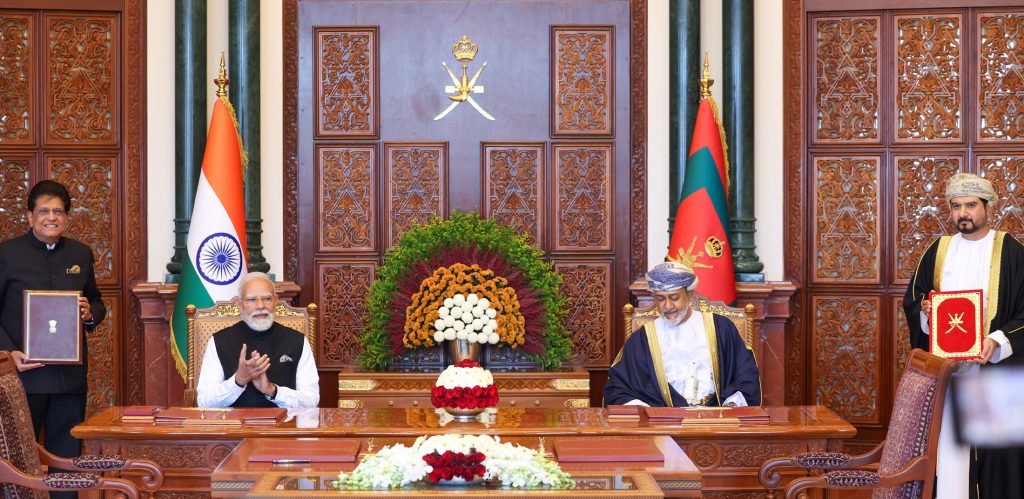
India and Oman have signed a landmark Comprehensive Economic Partnership Agreement (CEPA), marking a major step forward in their economic and strategic relationship. The agreement was signed under the leadership of Prime Minister Narendra Modi and Sultan Haitham bin Tarik, with Union Commerce and Industry Minister Piyush Goyal and Oman’s Minister of Commerce, Industry and Investment Promotion, Qais bin Mohammed Al Yousef, formalising the pact. The CEPA signals a new phase of cooperation between the two countries and strengthens India’s engagement with the Gulf region, where Oman plays a vital role as a trade and logistics gateway to the Middle East and Africa.
The agreement provides exceptional market access for Indian goods. Oman has agreed to eliminate customs duties on 98.08 per cent of its tariff lines, which covers over 99 per cent of India’s exports to the country by value. This move will directly benefit India’s labour-intensive sectors such as textiles, leather, footwear, gems and jewellery, engineering goods, plastics, furniture, agricultural products, pharmaceuticals, medical devices and automobiles. By reducing trade barriers, the CEPA is expected to boost exports, generate employment, and support artisans, women-led enterprises and micro, small and medium businesses across India.
India, in turn, has offered tariff liberalisation on around 78 per cent of its tariff lines, covering nearly 95 per cent of imports from Oman by value. For sensitive products, India has followed a cautious approach by offering limited access through tariff-rate quotas. Several key sectors, including dairy, tea, coffee, rubber, tobacco, precious metals, jewellery and select labour-intensive goods, have been kept outside the agreement to protect domestic interests. This balanced structure ensures that trade growth does not come at the cost of vulnerable sectors.
Services form a central pillar of the CEPA, reflecting India’s strength in this area. Oman has made ambitious commitments across 127 service sub-sectors, including information technology, business and professional services, research and development, education, healthcare and audio-visual services. These commitments are significant, as Oman’s services imports are valued at over USD 12 billion annually, while India’s share remains relatively modest. The agreement opens new high-value opportunities for Indian service providers and is expected to support skilled job creation and deeper commercial ties.
A key highlight of the CEPA is improved mobility for Indian professionals. For the first time, Oman has made wide-ranging commitments under Mode 4, allowing easier temporary entry and longer stays for Indian professionals. The quota for intra-corporate transferees has been increased substantially, while contractual service suppliers can now stay for up to two years, with the option of further extension. Entry and stay norms have also been liberalised for professionals in areas such as accountancy, taxation, architecture, medical and allied services, making cross-border professional engagement smoother.
The agreement also allows 100 per cent foreign direct investment by Indian companies in major services sectors in Oman, enabling Indian firms to expand their presence through commercial operations. In addition, both countries have agreed to explore social security arrangements in the future, once Oman’s contributory social security system is in place, which will help protect workers and improve labour mobility.
Another historic feature of the CEPA is Oman’s first-ever commitment on traditional medicine across all modes of supply. This creates strong opportunities for India’s AYUSH and wellness sectors, promotes medical value travel, and strengthens cooperation in traditional healthcare systems. The agreement also supports faster approvals for pharmaceutical products already cleared by leading global regulators and reduces compliance costs through acceptance of recognised quality certifications.
Overall, the India–Oman CEPA is expected to significantly expand bilateral trade, strengthen supply chains, create jobs and deepen long-term economic cooperation. It reflects India’s broader strategy of signing high-quality trade agreements that promote growth while safeguarding national interests.
Source: PIB