

India–EU Free Trade Deal Sealed, Opening a New Era of Global Trade
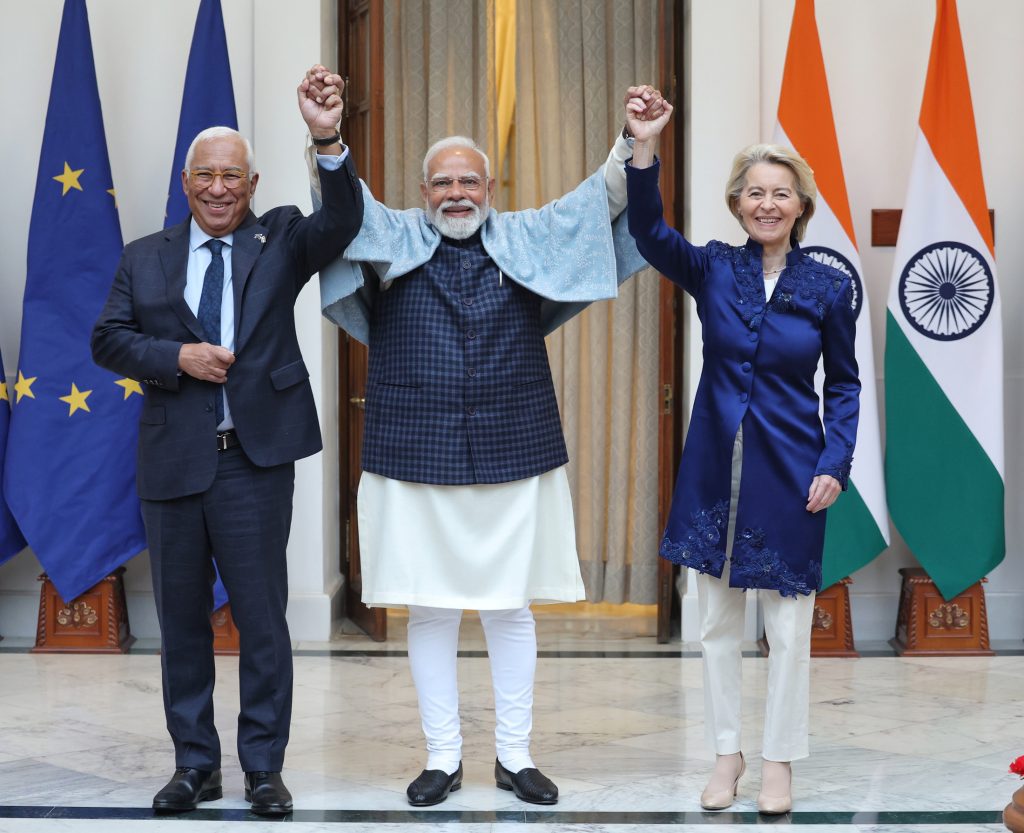
Photo Credit: PIB
India and the European Union have formally concluded the India–EU Free Trade Agreement, marking a major breakthrough in India’s global trade engagement. The announcement was made at the 16th India–EU Summit by Prime Minister Narendra Modi and European Commission President Ursula von der Leyen.
The agreement brings together the world’s fourth-largest economy, India, and the European Union, the second-largest economy, together accounting for nearly one-fourth of global GDP. This landmark deal reflects a shared commitment to open markets, long-term stability, and inclusive economic growth, while strengthening strategic ties between the two partners.
The India–EU FTA comes after several years of negotiations that were relaunched in 2022. Its conclusion signals strong political will on both sides to build a modern, balanced, and rules-based trade partnership. At a time when global trade is becoming more uncertain, the agreement sends a clear message of trust and cooperation between two major economic blocs.
The European Union is already one of India’s most important trading partners, with bilateral trade in goods reaching over USD 136 billion in 2024–25. India’s exports to the EU stood at around USD 75 billion, while services trade crossed USD 83 billion, highlighting the depth of the economic relationship.
One of the most significant outcomes of the agreement is the unprecedented market access secured for Indian exporters. More than 99 percent of Indian exports by value will receive preferential access to the EU market. This is expected to give a major boost to India’s exports, especially in labour-intensive sectors such as textiles, apparel, leather, footwear, marine products, gems and jewellery, handicrafts, engineering goods, and automobiles.
Nearly USD 33 billion worth of exports in these sectors will benefit from tariff reductions, many of which will drop to zero once the agreement comes into force. This will improve competitiveness, support MSMEs, and create new job opportunities for women, artisans, youth, and skilled professionals.
The agreement also supports the “Make in India” initiative through carefully planned and reciprocal market access arrangements. In the automobile sector, a calibrated and quota-based liberalisation approach has been adopted. This allows European manufacturers to introduce high-end vehicles in India, while also creating future opportunities for manufacturing and exports from India. Indian consumers are expected to benefit from access to advanced technologies and increased competition, while Indian-made automobiles will gain better access to the EU market over time.
India’s agricultural and processed food sectors are also set to benefit from the FTA. Products such as tea, coffee, spices, fruits, vegetables, and processed foods will gain improved access to the European market, helping farmers and rural enterprises expand their reach.
At the same time, India has protected sensitive sectors such as dairy, cereals, poultry, and certain fruits and vegetables by not offering market access, ensuring domestic interests remain safeguarded. This balanced approach supports export growth while protecting livelihoods at home.
Beyond tariffs, the agreement addresses non-tariff barriers by strengthening regulatory cooperation and improving transparency. It includes measures to streamline customs procedures, sanitary and phytosanitary standards, and technical regulations, making it easier for Indian businesses to trade with Europe. The agreement also includes forward-looking provisions related to the EU’s Carbon Border Adjustment Mechanism, ensuring dialogue, cooperation, and technical support to help Indian exporters adapt to emerging carbon-related requirements.
Services trade, which is a fast-growing part of both economies, plays a central role in the FTA. India has secured commercially meaningful commitments from the EU across key sectors such as IT and IT-enabled services, professional services, education, financial services, tourism, construction, and other business services. Indian service providers will benefit from predictable and non-discriminatory market access across 144 service subsectors in the EU. In return, EU service providers will gain access to 102 subsectors in India, encouraging investment, technology transfer, and innovation.
The agreement also includes a strong mobility framework that supports the movement of skilled and semi-skilled professionals. It provides clear and predictable rules for short-term business travel, intra-corporate transfers, and contractual service suppliers. Professionals in sectors such as IT, research and development, education, and professional services will benefit from these provisions. The FTA also supports discussions on social security arrangements, student mobility, and post-study work opportunities, further strengthening people-to-people ties.
In addition, the agreement promotes cooperation in emerging areas such as artificial intelligence, clean technologies, and semiconductors. It reinforces intellectual property protections in line with international standards, while recognising the importance of safeguarding traditional knowledge through initiatives like India’s Traditional Knowledge Digital Library. These provisions support innovation while respecting India’s cultural and knowledge heritage.
The India–EU FTA marks a new chapter in bilateral relations and positions India as a trusted and forward-looking global trade partner. Along with India’s trade agreements with the UK and EFTA, it effectively opens the broader European market for Indian businesses. Aligned with the vision of “Viksit Bharat 2047,” the agreement lays the foundation for inclusive, resilient, and future-ready growth, benefiting businesses, workers, farmers, and consumers on both sides.
Source: PIB