
Government Raises India’s Semiconductor Demand Forecast by 50% to $150 Billion by 2030

The Indian government has drastically increased its semiconductor demand predictions, increasing the expected market size by 50% to $150 billion by 2030. The new prediction takes into account the country’s fast developing electronics manufacturing sector, as well as the growing popularity of artificial intelligence (AI), electric vehicles (EVs), 5G infrastructure, consumer electronics, and industrial automation.
The updated prediction emphasises India’s expanding significance as one of the world’s fastest-growing semiconductor markets, as well as the government’s goal of making the country a global hub for semiconductor manufacture and design. The increased demand estimate is expected to boost investor confidence and spur new investments in semiconductor fabrication, chip design, assembly, testing, packaging, and essential component manufacture.
Government officials credit the higher revision to robust domestic consumption, accelerating digital transformation, and legislative actions geared at supporting the electronics industry. Flagship programmes such as the India Semiconductor Mission (ISM), the Production Linked Incentive (PLI) scheme, and the Electronics Components Manufacturing Scheme (ECMS) have attracted significant investments from both domestic and international companies, laying the groundwork for a strong semiconductor ecosystem.
Semiconductor demand is being driven by multiple high-growth sectors in India.The rapid expansion of electric mobility, renewable energy, data centres, telecommunications, defence electronics, aerospace, healthcare devices, and consumer electronics has substantially increased the requirement for semiconductor chips. The proliferation of AI-powered applications and smart devices is also expected to fuel demand for advanced processors and memory technologies over the coming years.
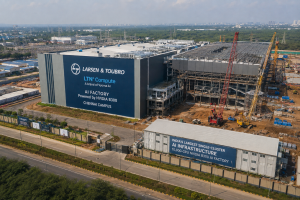
The increased projection comes as India continues to experience exceptional growth in electronics manufacturing. The country has evolved as a significant manufacturing hub for cellphones, IT gear, and consumer electronics, with various semiconductor projects being developed in Gujarat, Assam, and other states. The government believes that a robust domestic semiconductor industry will minimize import dependence while also improving supply chain resilience in the face of persistent geopolitical uncertainty.
Many people believe that India’s semiconductor demand is rising rapidly, and domestic manufacturing capacity is still in its early stages. At present, the country imports a significant portion of the semiconductors used by its electronics industry. This gap presents a substantial opportunity for investments in fabrication plants, outsourced semiconductor assembly and test (OSAT) facilities, advanced packaging, chip design, and compound semiconductor manufacturing.
As global supply chains continue to diversify beyond traditional manufacturing centres, the nation’s growing domestic markets offer a compelling value proposition for international semiconductor companies. The higher demand forecast is likely to encourage technology partnerships, foreign direct investment, and greater participation by Indian startups in chip design and semiconductor innovation.
With semiconductor demand now projected to reach US$150 billion by 2030, India is positioning itself not only as a major consumer of chips but also as an emerging manufacturing and innovation hub capable of supporting the next generation of global electronics and digital technologies.
Source: The Economic Times