

ICEA Panel at Electronica India 2026: Capital Goods, Robotics & Automation Are India’s Next Electronics Frontier
India’s Electronics Manufacturing Next Chapter Will Be Written in Its Machines
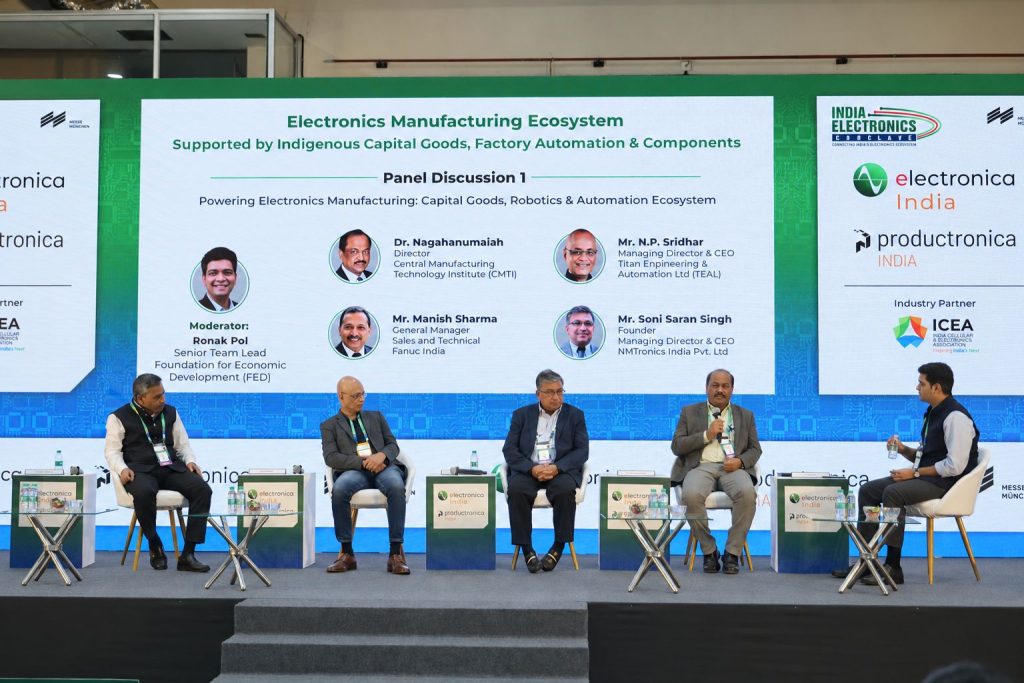
At Electronica India 2026, ICEA hosted a panel discussion on “Powering Electronics Manufacturing: Capital Goods, Robotics & Automation Ecosystem” a conversation that cut through the headline numbers to address what actually determines whether India’s electronics ambition holds at scale.
The panel brought together Sridhar Neelakantan, MD & CEO of Titan Engineering & Automation Limited (TEAL); Manish Sharma, GM Sales and Technical at FANUC India; Soni Saran Singh, Founder, MD & CEO of NMTronics India; and Dr. Nagahanumaiah, Director of CMTI Central Manufacturing Technology Institute, with Ronak Pol of the Foundation for Economic Development moderating.
Three themes ran through the discussion with particular force.
The first was talent. With India’s electronics production crossing Rs 13.1 lakh crore in FY26 and mobile manufacturing now spanning nearly 300 plants, the industry’s most immediate constraint is not capital or policy it is engineers who can walk onto a production floor and contribute from day one. The panel was direct: mechatronics needs to be positioned as an aspirational engineering discipline, and structured internship pipelines running from college into corporate are not a nice-to-have but an operational necessity.
The second was the inverted duty structure that continues to penalise domestic capital goods manufacturers. If India intends to build the machines that power its electronics factories, its tariff architecture must reward the domestic manufacturer rather than the importer. This correction, the panelists noted, is foundational not incremental.
The third was a call to build from India’s existing strengths rather than reflexively benchmarking every gap against imported solutions. India’s design talent, its manufacturing base, and its institutional R&D infrastructure represented in the room by CMTI are genuine starting points for the capital goods and automation story the country is now writing.
ICEA thanks Messe Muenchen India for the platform and the distinguished panelists for a conversation that brought clarity to what India’s path to $500 billion in electronics manufacturing actually requires not just finished devices, but the machines, the automation, and the people that make world-class production possible.